Why Concert Programmes Put Pieces in an Order
Why concert programmes put pieces in an order: learn how timings, intervals and practical constraints shape a concert, so you can read the evening with ease.
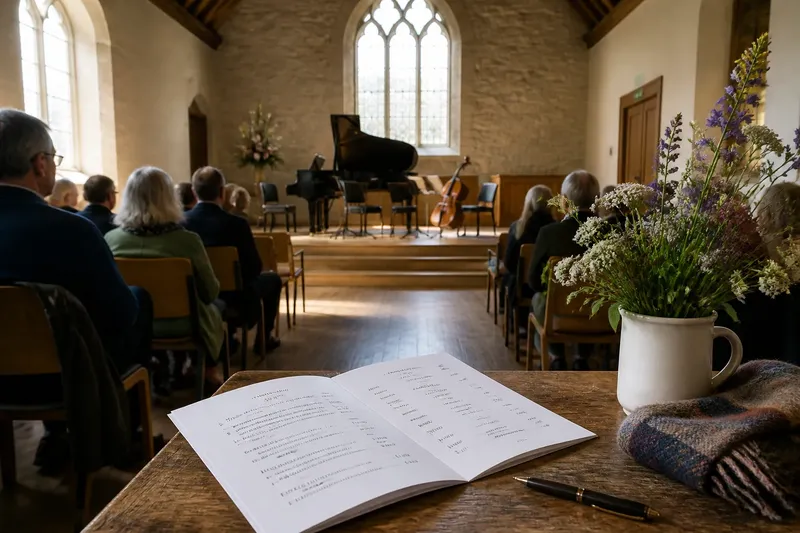
Why concert programmes put pieces in an order is often a practical question: a long work may need an interval, performers may need time to change instruments, and a venue may have a firm closing time. At a village hall or church, those decisions can shape the evening as much as the music itself.
Read the programme as a plan for people, performers and a particular room. Its sequence can reveal when to settle in, when a pause is likely, and what to expect if a work needs a different set-up.
Practical constraints
Performers cannot always move directly from one piece to the next. A musician may need to change instrument, retune, adjust a music stand or wait while the ensemble rearranges chairs. Placing a short item between larger works can give that change a natural place in the evening.
The room matters too. A church with a reverberant acoustic may need a quiet moment after a resonant work before the next begins. In a village hall, moving a piano or resetting the stage can take attention and time. A pause in the programme can serve a clear practical purpose rather than signalling a musical connection.
Look for stage directions such as “interval”, “pause” or a note that performers will leave the stage. These clues help you know whether to remain seated, stretch your legs or expect a brief reset.
Notice the practical information before the lights dim; it makes the transitions easier to follow.
Reading the timings
Printed timings are usually estimates, not promises of an exact finish. Applause, introductions, tuning and changes between works can affect the running order. If you need to arrange a lift from a rural venue, ask the organiser about the likely finish rather than treating a printed duration as a precise departure time.
Check whether the programme gives timings for individual works, an interval, or the whole event. A listed interval may include time to leave the room and return, while a pause between pieces may be only a short reset. If no timings appear, the venue or presenter may be able to clarify the broad schedule.
Say you have a hypothetical concert listing that names a long first half, an interval and a final work, but gives no end time. You want to decide whether to book a lift. First, check the venue’s listing for a stated finish; next, contact the organiser if it is absent; then tell the driver the organiser’s estimate and allow flexibility for applause or a slower changeover. The resulting decision is whether the lift can wait nearby or should be arranged for a later, more flexible pick-up.
Set changes and pauses
A different grouping of performers can explain why works are separated. A soloist may perform alone before joining an ensemble; a choir may leave the stage while instrumentalists prepare. The programme order can reduce awkward movement and let the audience understand why the room goes quiet.
For a countryside venue with limited stage space, performers may need to move chairs or stands by hand. Avoid treating a pause as empty time: it may be the moment when the next part of the concert becomes possible.
If you are unsure whether a break is an interval, watch for a spoken announcement or a clear invitation to leave the room. When in doubt, ask an usher or venue volunteer before stepping outside.
What should I check?
Does the programme list an interval?
Look for a printed interval marker or an announcement from the presenter. If one appears, you can plan a short break; if not, stay ready for a brief pause between works instead.
Are timings exact?
Treat printed timings as a guide because applause and stage changes can alter the flow. If you have transport to arrange, ask the organiser for a likely finish and keep the pick-up flexible.
Why do performers leave the stage?
They may be changing instruments, resetting the ensemble or preparing a different group of performers. If the programme gives no explanation, wait for an announcement rather than assuming the concert has ended.
Where can I confirm the schedule?
Check the venue’s event listing or contact the organiser, especially if you need to coordinate a lift or public transport. If details remain unclear, plan around the later plausible finish rather than relying on a tight connection.
Before you travel
Use this quick check to decide what to confirm before setting off:
- Finish time: If the listing gives a likely finish, share it with your driver; if it gives none, ask the organiser and arrange a flexible pick-up.
- Interval: If an interval is listed, decide whether you will stay in the venue or step outside; if no interval appears, keep essentials close in case the pause is brief.
- Transport: If a bus or lift depends on a precise departure, confirm the concert schedule; if timing is uncertain, choose a later or more adaptable option.
- Venue access: If the listing explains the entrance or parking arrangements, follow those directions; if it is unclear, contact the venue before travelling.
- Programme changes: If the organiser announces a substitution, use the revised order for planning; if no update is given, ask a steward rather than relying on an old listing.
- Leaving early: If you must leave before the end, check with the venue about a suitable exit; if movement would disrupt performers or listeners, arrange to remain until a pause.
Why concert programmes put pieces in an order becomes easier to understand when you notice the logistics behind each transition. The practical details do not dictate how you should listen; they help you arrive prepared and give the evening room to unfold.