One Question to Carry into a First Concert
A first concert listening plan helps you notice how performers shape sound through pace, balance and silence, without needing to follow every musical detail.
At a village hall concert, the first chord rings out and you may wonder what to listen for. A first concert listening plan can give you a useful answer: pay attention to how the performers shape the sound, rather than trying to trace a tune through the piece. Notice changes in volume, pace, balance or silence; these are audible even when you do not know the music.
Choose a listening focus
Before the concert, glance at the programme and choose one simple quality to notice. A description might mention a lively section, a quiet passage or a change in mood. Turn that clue into a question such as, “How does the music grow louder?” or “What makes this passage feel calm?”
If the programme offers no useful description, choose something you can hear without technical knowledge: the strength of the beat, the space between sounds, or whether one instrument stands out from the others. Keep the question open. You are listening for an experience, not checking whether the performance matches a prediction.
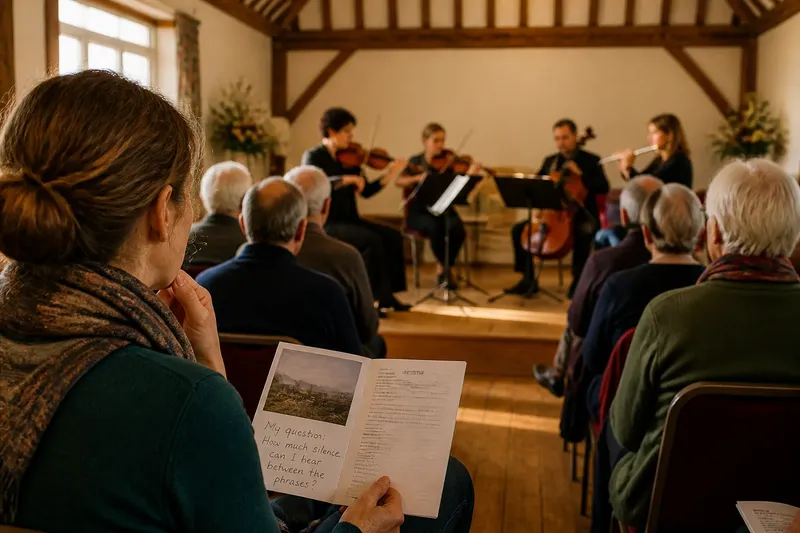
Write the question on the programme margin or keep it in mind. One focus is enough; leave room for unexpected sounds to catch your attention.
Before the concert
When you check the programme, read the title and any short description of one piece. There is no need to learn unfamiliar terms. If the notes mention a contrast between quiet and loud, for instance, you might listen for how sharply that contrast is made.
You could also hear a recording beforehand if one is readily available, but it is optional. A recording may make the instruments or broad shape more familiar; the live performance may sound different in the village hall. Treat the recording as an introduction, not a version the players must reproduce.
Say you have chosen a piece described as calm and spacious. Your question could be, “How much silence can I hear between the phrases?” You might notice a pause that feels long, or realise that the sounds join more closely than expected. Either observation gives you something concrete to listen for without requiring specialist knowledge.
Settle into the room
Arrive with time to find your seat and put away anything that could distract you. In a small hall, the sound may feel close, and you may hear the room as well as the players: a chair shifting, a door closing or a brief echo. These details do not need to become a problem. Let them pass, then return to the quality you chose.
Before the music begins, remind yourself of your question once. During the performance, listen for the overall effect before trying to identify its cause. A passage may seem more forceful because it is louder, because the rhythm feels firmer, or because the other instruments have become quieter.
If your attention wanders, do not try to reconstruct what you missed. Rejoin by noticing what the room and music sound like now: is the pace steady or changing, is the texture full or sparse, is there a pause?
Notice the sound?
What should I listen for at a first concert?
Choose one audible quality, such as pace, volume, silence or the balance between instruments. A simple question about that quality gives your attention a place to rest without turning the concert into a test.
What if I cannot identify the instruments?
You can describe what you hear without naming its source: a high sound, a deep sound, a sharp attack or a sustained note. If you later recognise an instrument, treat that as an extra detail rather than a requirement.
Should I follow the programme while listening?
Read the notes before the piece or during an interval if that suits you. If looking down makes you lose the sound, leave the programme closed and listen to the music in front of you.
What if the hall is noisy?
Let ordinary room sounds pass when you can, then bring your attention back to the music’s pace, volume or pauses. If a practical issue is preventing you from hearing comfortably, ask an usher or organiser for help between pieces.
After the performance
When the applause starts, recall one thing you noticed about the sound. You might remember that a quiet passage felt spacious, or that a steady beat made the final section feel more energetic. A short note in the programme margin can help you remember the experience without making it a technical account.
Imagine you chose to listen for pauses in a calm piece. You arrive with that question in mind, hear the performers leave a clear gap between two phrases, and notice that a later pause feels shorter because the next sound follows quickly. Your resulting observation might be, “The silences did not all feel the same.” You have followed your chosen focus and gained a specific impression, even if you cannot explain the music’s structure.
For your next first concert listening plan, choose a question that leaves you curious rather than worried about keeping up. The sound of the room, the space between phrases and the way performers balance their parts can all reward attention without demanding that you name every note.